
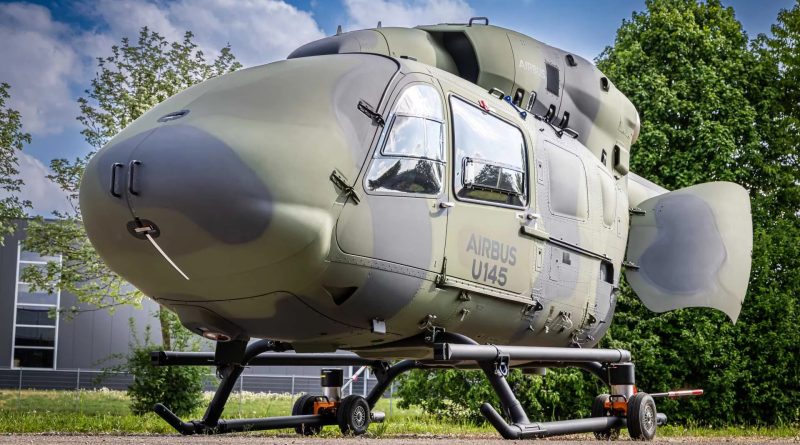
Airbus Unveils U145 Autonomous Military Helicopter Designed for Unmanned Combat and Rescue Operations
European aerospace giant Airbus has announced the development of the U145, a groundbreaking autonomous unmanned helicopter specifically engineered for military applications. This innovative aircraft represents a significant leap forward in military aviation technology, designed to perform critical missions including cargo delivery and casualty evacuation without requiring human pilots on board. The announcement marks Airbus’s strategic move to compete in the rapidly expanding market for autonomous military vehicles, where demand has surged dramatically in recent years due to evolving battlefield requirements and the increasing emphasis on minimizing risk to military personnel.
The U145 is based on the proven H145 helicopter platform, which has been a workhorse in both civilian and military operations worldwide for over a decade. By leveraging this established airframe, Airbus aims to accelerate development timelines while ensuring the reliability and performance characteristics that operators have come to expect from the H145 family. The conversion to autonomous operation involves integrating advanced sensor suites, artificial intelligence-driven flight control systems, and sophisticated obstacle avoidance technology that enables the aircraft to navigate complex environments independently. This approach of adapting existing platforms rather than developing entirely new aircraft from scratch has become increasingly popular in the defense industry, as it significantly reduces development costs and certification challenges.
The autonomous helicopter’s primary missions will focus on logistics support and medical evacuation operations, two of the most dangerous tasks faced by military aviation crews. In modern combat zones, supply convoys and medevac flights frequently come under enemy fire, making them high-risk operations that have historically resulted in significant casualties among helicopter crews. By removing human pilots from these missions, military planners can conduct essential operations without exposing personnel to hostile fire. According to military analysts, autonomous cargo delivery systems could revolutionize battlefield logistics by enabling continuous supply operations regardless of weather conditions, visibility, or threat levels that would normally ground manned aircraft.
The medical evacuation capability of the U145 is particularly significant given the critical importance of the “golden hour” in combat medicine. Military medical doctrine emphasizes that wounded soldiers who receive definitive care within sixty minutes of injury have dramatically higher survival rates. Autonomous medevac helicopters could potentially respond faster to casualty reports and fly more direct routes without consideration for crew safety, potentially saving lives that might otherwise be lost. The U145 is expected to feature specialized medical equipment bays and could potentially be configured to provide basic automated medical monitoring during transport, though Airbus has not yet released detailed specifications on these capabilities.
The development of the U145 comes amid a broader transformation in military aviation driven by advances in artificial intelligence and autonomous systems. Major defense contractors worldwide are racing to develop unmanned combat and support aircraft, recognizing that future conflicts will increasingly feature autonomous platforms operating alongside or instead of manned systems. The United States military has already deployed autonomous cargo delivery drones in limited capacities, while several nations are actively testing autonomous helicopter systems for various applications. Airbus’s entry into this market with a full-sized helicopter platform represents an escalation in the capabilities being offered, moving beyond smaller drone systems to aircraft capable of carrying substantial payloads over extended distances.
The European defense industry has been working to maintain technological parity with American and Chinese competitors in the autonomous systems domain, and the U145 represents a significant step in that direction. Airbus Helicopters, headquartered in Marignane, France, has invested heavily in autonomous flight technology over the past several years, conducting numerous test flights with progressively more sophisticated systems. The company has also partnered with various European defense ministries to ensure that the U145 will meet the operational requirements of potential customers. Industry observers note that European nations have shown particular interest in autonomous systems as a means of maintaining military capabilities despite declining defense budgets and shrinking military personnel pools.
While Airbus has not announced a specific timeline for the U145’s operational deployment or identified initial customers, the company has indicated that prototype testing is already underway. The certification process for autonomous military aircraft remains complex, as regulatory frameworks are still evolving to address the unique challenges posed by unmanned systems operating in shared airspace. Nevertheless, military applications typically face less stringent civilian aviation certification requirements, potentially accelerating the path to operational service. As autonomous technology continues to mature and gain acceptance among military planners, aircraft like the U145 are expected to play an increasingly prominent role in future military operations, fundamentally changing how armed forces conduct logistics and casualty evacuation missions.