
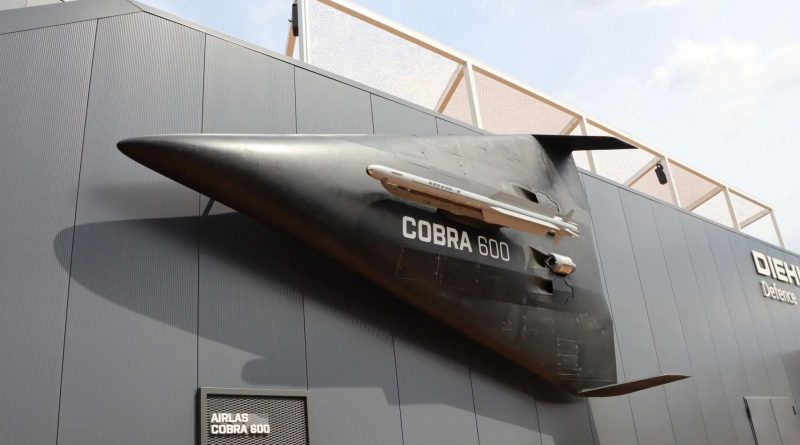
Germany Unveils Cobra 600 Drone Capable of Launching IRIS-T Missiles at Ranges Up to 400 Kilometers
Germany has officially presented its latest advancement in unmanned aerial combat technology: the Cobra 600 drone, a sophisticated platform designed to carry and launch IRIS-T air-to-air missiles at distances of up to 400 kilometers. This groundbreaking system represents a significant leap forward in aerial defense capabilities, allowing military forces to engage hostile targets well beyond the reach of traditional ground-based air defense systems. The unveiling marks another milestone in Germany’s growing commitment to developing cutting-edge defense technologies amid evolving security challenges across Europe.
The Cobra 600 drone system has been specifically engineered to extend the operational range of the proven IRIS-T missile family, which has already demonstrated remarkable effectiveness in various combat scenarios. By mounting these highly capable missiles on an unmanned platform, German defense engineers have effectively created a mobile launch system that can penetrate deep into contested airspace without risking pilot lives. This approach reflects a broader shift in modern warfare doctrine, where unmanned systems are increasingly taking on roles previously reserved for manned aircraft, offering both tactical flexibility and reduced human risk.
The IRIS-T missile itself has earned a stellar reputation among defense experts worldwide. Originally developed as an infrared-guided short-range air-to-air missile by a European consortium led by Germany’s Diehl Defence, the IRIS-T has evolved into a versatile family of weapons systems. The ground-based IRIS-T SLM variant has seen active deployment in Ukraine’s air defense network, where it has achieved impressive intercept rates against Russian cruise missiles, drones, and even ballistic missiles. Germany’s decision to integrate this proven technology onto a drone platform demonstrates a strategic vision for maximizing the utility of existing weapons systems while adapting to modern battlefield requirements.
The strategic implications of the Cobra 600 system are substantial. Traditional air defense systems, while highly effective, are inherently limited by their fixed or semi-mobile nature. Ground-based launchers must contend with terrain constraints, vulnerability to counter-battery fire, and the challenge of repositioning quickly enough to respond to dynamic threats. By contrast, the Cobra 600 can be launched from positions far behind friendly lines, fly autonomously toward the engagement zone, and release its payload at optimal range before returning or proceeding to a recovery point. This capability essentially transforms air defense from a static shield into a dynamic, far-reaching offensive tool.
Defense analysts have noted that the development of systems like the Cobra 600 reflects lessons learned from recent conflicts, particularly the ongoing war in Ukraine. That conflict has demonstrated both the critical importance of air defense and the vulnerabilities of traditional systems to saturation attacks and precision strikes. Ukrainian forces have repeatedly emphasized the need for more flexible, distributed air defense architectures that can survive in contested environments. Germany’s new drone-missile combination addresses these concerns by creating a system that is inherently harder to locate, track, and destroy than conventional fixed installations.
The 400-kilometer operational range of the Cobra 600 places it firmly in the category of medium-range strike systems, capable of engaging targets across a substantial operational area. For context, this range would allow a drone launched from western Germany to reach targets deep into Eastern European airspace, or enable forces defending Baltic states to engage threats originating from considerable distances. Such capabilities align with NATO’s evolving defense posture, which increasingly emphasizes extended deterrence and the ability to project defensive power across the alliance’s eastern flank.
Germany’s defense industry has undergone a remarkable transformation since the Russian invasion of Ukraine in February 2022, which prompted Berlin to announce a historic 100 billion euro special fund for military modernization. The unveiling of the Cobra 600 represents one tangible result of this renewed investment in defense innovation. As European nations continue to reassess their security needs in an increasingly uncertain geopolitical environment, systems like the Cobra 600 are likely to attract significant interest from allied nations seeking to enhance their own defensive capabilities. The integration of proven missile technology with advanced drone platforms points toward a future where unmanned systems play an ever-larger role in both offensive and defensive military operations.