
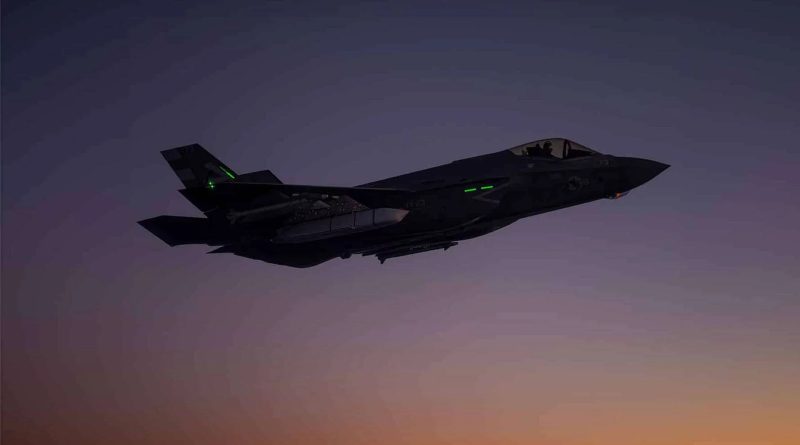
F-35C Successfully Tests LRASM Anti-Ship Missile for Long-Range Naval Strike Capability
The United States Navy has achieved a significant milestone in expanding the combat capabilities of its fifth-generation stealth fighter, with the F-35C Lightning II successfully completing its first test flight carrying the Long Range Anti-Ship Missile (LRASM). This development marks a crucial step forward in the Navy’s efforts to enhance its ability to engage enemy surface vessels from extended distances while maintaining the stealth advantages that define the F-35 platform.
The LRASM represents one of the most advanced anti-ship weapons in the American arsenal. Developed by Lockheed Martin, this sophisticated cruise missile possesses autonomous target acquisition and tracking capabilities, meaning it can independently locate, identify, and pursue enemy vessels without constant guidance from the launching aircraft. This feature is particularly valuable in contested environments where communication links may be disrupted by enemy electronic warfare systems. The missile utilizes a combination of onboard sensors, including infrared imaging and radar, to navigate toward its target while evading defensive countermeasures.
The integration of LRASM with the F-35C carrier variant opens new tactical possibilities for the U.S. Navy’s carrier strike groups. The F-35C’s stealth characteristics allow it to penetrate deeper into enemy airspace without detection, potentially launching attacks against hostile surface fleets from positions that would be inaccessible to conventional aircraft. Combined with the LRASM’s reported range of approximately 200 nautical miles or more, this pairing creates a formidable threat to adversary naval forces. The missile’s ability to fly at low altitudes and execute evasive maneuvers makes it particularly difficult to intercept.
This capability enhancement comes at a time of increasing concern over the growing naval power of potential adversaries, particularly China’s rapidly expanding People’s Liberation Army Navy. The Chinese fleet has grown to become the world’s largest by number of vessels, and its anti-access/area denial strategy poses significant challenges to American power projection in the Western Pacific. The development of long-range strike capabilities from carrier-based aircraft represents a direct response to these evolving threats, allowing U.S. forces to engage enemy ships while remaining outside the range of many defensive systems.
The LRASM program itself has undergone substantial development since its inception as a Defense Advanced Research Projects Agency (DARPA) initiative in 2009. Originally designed to address the urgent need for a next-generation anti-ship missile following the retirement of older systems, the weapon entered service with the U.S. Air Force on B-1B Lancer bombers in 2018 and subsequently with Navy F/A-18E/F Super Hornets. The expansion to the F-35C platform represents the latest phase in the missile’s integration across multiple American combat aircraft, enhancing the flexibility of naval strike operations.
Military analysts emphasize that the combination of stealth aircraft and autonomous missiles fundamentally changes the calculus of naval warfare. Unlike previous generations of anti-ship missiles that required continuous target updates from the launching platform, the LRASM’s artificial intelligence allows the aircraft to disengage immediately after launch, reducing its exposure to enemy defenses. This “fire and forget” capability, combined with the missile’s sophisticated electronic warfare suite that can jam and confuse defensive radar systems, makes it exceptionally difficult for targeted vessels to defend themselves effectively.
The successful integration test is expected to be followed by additional evaluation flights and ultimately operational deployment with carrier air wings. Defense officials have indicated that the F-35C’s software and weapons bay configurations will continue to be updated to fully optimize the aircraft’s performance with LRASM. As great power competition intensifies in maritime domains around the world, from the South China Sea to the Baltic Sea, the enhanced strike capability provided by this weapons combination will likely play an increasingly important role in American naval strategy and deterrence posture for decades to come.