
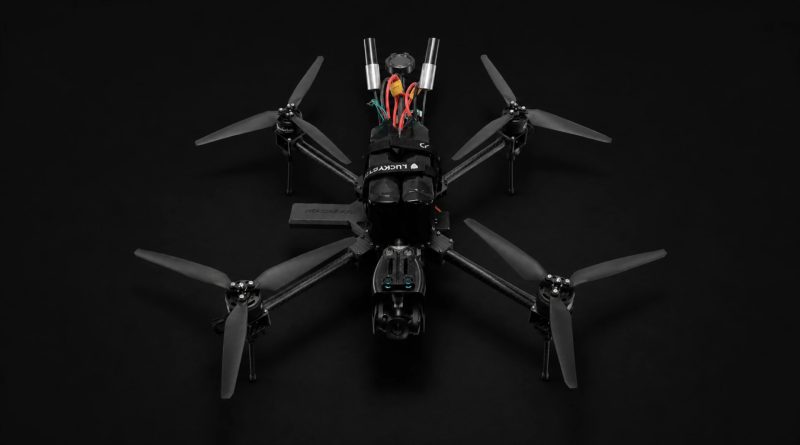
Ukrainian Lucky Strike-2.1 Drone Equipped with GPS-Independent Navigation System
Ukraine’s defense technology sector has achieved another significant milestone in its ongoing efforts to develop autonomous military capabilities. The Lucky Strike-2.1 reconnaissance and strike drone has been upgraded with a sophisticated navigation system that operates independently of GPS signals, marking a crucial advancement in the country’s unmanned aerial vehicle technology. This development comes as electronic warfare has become an increasingly critical battlefield factor in the ongoing conflict with Russia, where both sides actively jam satellite navigation systems.
The upgraded Lucky Strike-2.1 maintains its impressive operational capability of deploying up to three munitions during a single sortie, making it a versatile platform for precision strikes against enemy positions. The integration of GPS-independent navigation represents a direct response to the challenges Ukrainian forces have faced on the front lines, where Russian electronic warfare systems routinely disrupt satellite signals across vast areas. This technological adaptation demonstrates Ukraine’s ability to innovate rapidly under combat conditions and address real-world battlefield requirements.
The significance of GPS-free navigation cannot be overstated in modern warfare. Traditional drones rely heavily on Global Positioning System satellites to determine their location and navigate to targets. However, adversaries have developed powerful jamming equipment that can block or spoof these signals, causing drones to lose their way, crash, or even return to unintended locations. Russia has invested heavily in electronic warfare capabilities, deploying systems like the Pole-21 and Krasukha-4 that can create GPS-denied environments spanning dozens of kilometers. By developing alternative navigation methods, Ukrainian engineers have effectively neutralized a key Russian defensive advantage.
The Lucky Strike series has evolved considerably since its initial deployment. Earlier versions relied primarily on operator control and basic autonomous flight modes, but the 2.1 variant represents a quantum leap in capability. The drone reportedly uses a combination of inertial navigation systems, terrain-matching algorithms, and visual recognition technology to maintain accurate positioning without satellite assistance. Such systems work by comparing sensor data against pre-loaded maps and using onboard accelerometers and gyroscopes to track movement from a known starting point. While these technologies have existed for decades in cruise missiles and advanced military aircraft, adapting them for smaller, cost-effective drones represents a significant engineering achievement.
Ukraine’s drone warfare capabilities have expanded dramatically since February 2022, transforming from a minor component of military operations into a central element of the country’s defense strategy. The nation has cultivated a thriving ecosystem of drone manufacturers, with dozens of companies producing everything from small reconnaissance quadcopters to long-range strike platforms capable of reaching targets deep inside Russian territory. This decentralized approach to defense production has proven remarkably resilient, with multiple redundant suppliers ensuring that the loss of any single manufacturer does not cripple overall capabilities. The Lucky Strike-2.1 emerges from this innovative environment, benefiting from rapid iteration cycles and direct feedback from combat units.
Military analysts have noted that the development of GPS-independent navigation could have implications far beyond the current conflict. As electronic warfare capabilities proliferate globally, armed forces worldwide are grappling with how to maintain precision strike capabilities in contested electromagnetic environments. Ukraine’s battlefield-tested solutions may eventually find their way into export markets, potentially reshaping the global drone industry. The country has already become a significant source of innovation in unmanned systems, with lessons learned in combat against a peer adversary proving invaluable for developing next-generation technologies.
The ability to deliver multiple munitions per sortie significantly enhances the Lucky Strike-2.1’s tactical value compared to single-payload alternatives. Operators can engage multiple targets or strike a single high-value objective with redundant munitions to ensure destruction. This capability, combined with GPS-independent navigation, creates a platform that can operate effectively even in the most challenging electronic warfare environments. As Ukraine continues to develop its indigenous defense industry, systems like the Lucky Strike-2.1 demonstrate the nation’s growing technological sophistication and its determination to achieve battlefield advantages through innovation rather than simply matching enemy numbers.