
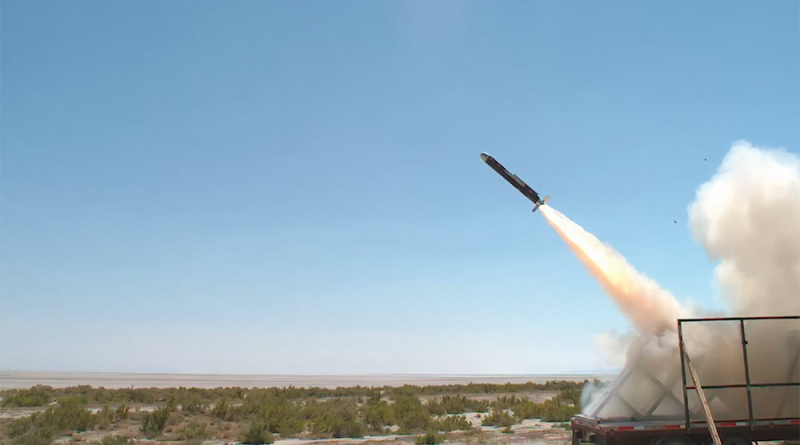
United States Successfully Tests Jackal Missile Capable of Rapid Strikes Up to 125 Kilometers
Defense contractor Northrop Grumman has successfully conducted comprehensive testing of its new Jackal missile system, demonstrating the weapon’s capabilities under challenging combat conditions. The trials validated the missile’s ability to deliver rapid precision strikes against targets located up to 125 kilometers away, marking a significant milestone in the development of next-generation tactical munitions for the United States military. The successful tests represent another step forward in America’s ongoing efforts to maintain technological superiority in modern warfare scenarios.
The Jackal missile system has been designed specifically to address emerging threats on the contemporary battlefield, where speed, precision, and adaptability are paramount. Military strategists have increasingly emphasized the need for weapons that can respond quickly to time-sensitive targets while maintaining accuracy in contested environments. The 125-kilometer range places the Jackal in a critical operational niche, allowing forces to engage enemy positions from standoff distances while remaining outside the effective range of many short-range air defense systems that have proliferated globally in recent years.
Northrop Grumman, one of America’s largest defense contractors with a long history of developing advanced weapons systems, designed the Jackal to operate effectively in what military planners describe as complex or degraded environments. These scenarios include situations where electronic warfare, GPS jamming, and other countermeasures might be employed by adversaries. The testing program specifically evaluated the missile’s performance under such conditions, ensuring that it can maintain its guidance accuracy and strike capabilities even when facing sophisticated enemy defensive measures.
The development of the Jackal comes amid a broader transformation in military thinking about tactical strike capabilities. Lessons learned from recent conflicts, including observations of warfare in Ukraine, have highlighted the critical importance of long-range precision fires in modern combat operations. Both the United States Army and Marine Corps have been actively pursuing new missile systems that can provide ground forces with organic deep-strike capabilities, reducing dependence on air support and enabling faster response times against emerging threats.
The missile’s design philosophy reflects contemporary trends in weapons development that prioritize modularity and adaptability. Modern military systems are increasingly built to accommodate future upgrades and modifications, allowing them to evolve alongside changing threat landscapes without requiring complete redesigns. This approach not only extends the operational lifespan of weapons platforms but also provides cost efficiencies for military procurement programs that often span decades. The Jackal’s architecture reportedly incorporates these principles, potentially allowing for enhancements to range, guidance systems, or warhead configurations as technology advances.
Industry analysts note that the 125-kilometer strike range positions the Jackal competitively within the growing market for tactical missiles. This capability exceeds that of many currently fielded systems while remaining practical for deployment from mobile ground platforms. The ability to launch rapid strikes at such distances could prove particularly valuable in Pacific theater scenarios, where military planners anticipate potential conflicts might involve island-hopping operations and engagements across maritime environments. American military doctrine has increasingly focused on distributed operations and the ability to project power from dispersed positions, making weapons like the Jackal essential components of future force structures.
The successful testing of the Jackal missile system represents continued investment by the United States in maintaining its edge in precision strike capabilities. As potential adversaries develop increasingly sophisticated air defense networks and electronic warfare systems, American weapons developers face constant pressure to create munitions that can penetrate these defenses reliably. Northrop Grumman’s demonstration that the Jackal can perform effectively under challenging conditions suggests the company has made meaningful progress toward meeting these demanding requirements. Further testing and evaluation will likely continue as the system moves through the defense acquisition process toward potential operational deployment with American forces.